
Dolly Parton is angry
We are in France because, as we do every year, we are looking after a farm for a few weeks. The farmer and his wife then go on vacation. Since all the work is contracted out, it is a vacation for us too. We do not have to work; we are basically a gentleman farmer and a lady farmer.
We receive the warmest of welcomes. The dogs jump out of the car and immediately seem at home. So do we, and what always strikes us most is the silence, the deafening silence.
Suddenly, however, that silence is rudely shattered by a great commotion among the chickens and the yapping of the dachshund. We hurry over, but of course it is too late. Queen Sophie is proudly tugging at the remains of a chicken.
"Things went fine with that dachshund and the chickens last time, didn't they?" the farmer asks.
"Yes, but never without supervision," I tell him. "We always kept an eye on things."
"Well, no harm done," he says. "They need replacing anyway. Too old, and too few eggs."
I normally bring homemade bitterballen along for the hunt, but I hadn't gotten around to it this time. I suggest slaughtering the chickens and using the meat for the bitterballen, since they are only good as stewing hens now. We will make some bitterballen for our stay, then slaughter the remaining chickens when the farming couple returns and make another batch. So that is what we do.
Once we have settled in, it is time for the apéro. Even at the end of February, we can sit on the terrace until late. What an extraordinary spring this is.
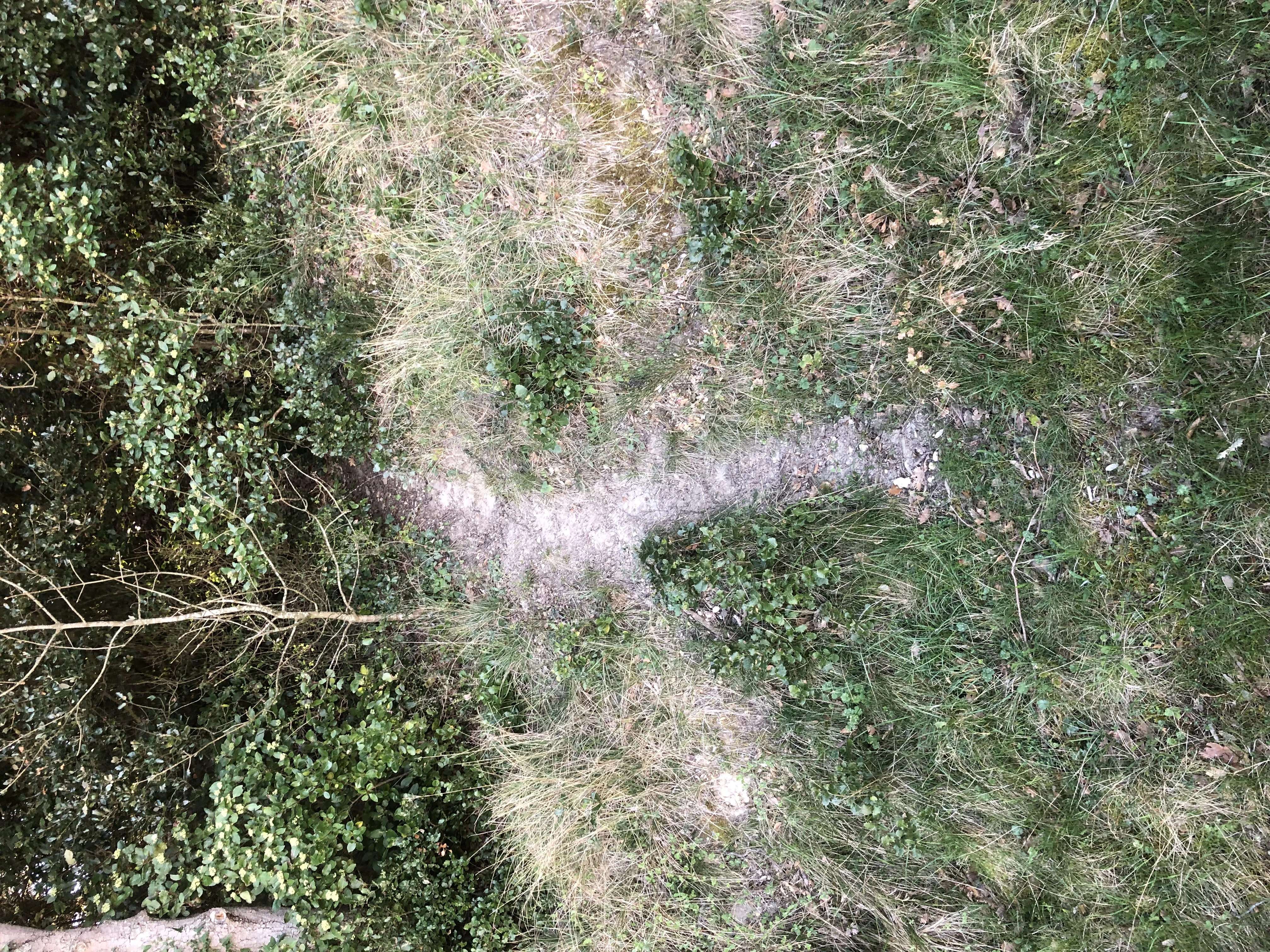
After seeing the couple off the next day, I take a walk around the area. There is little sign to read because it has not rained here for weeks. The fields are made up of a kind of loess, loose, sticky clay, but it has now formed a rock-hard layer. Despite the high temperatures, the winter wheat has barely started growing, and the rapeseed looks poor. Beside a patch of dense cover, I spot a heavily used wild-boar trail. That makes sense, because the boar use it to reach the little river below.
 Monsieur le President of the local hunting club, the ADCA, drops by. He is a nice fellow who, having heard in the village that we have arrived again, comes over for a drink and invites us to the barbecue marking the end of the hunting season.
The atmosphere in the club's hunting cabin is convivial. The President tells his hunting buddies that they had better stay on good terms with that "maraudeur Hollandais": we have been bringing them bitterballen & genever for years. For my part, I want to keep them happy too. If I find crop damage in the fields, there might even be special authorization for me to shoot wild boar after the season has closed...
To improve my chances a little more, I tell them that this time we have brought bitterballen of our own making, but of origen français, while the next stoneware jug, of origen néerlandais, is already being opened.
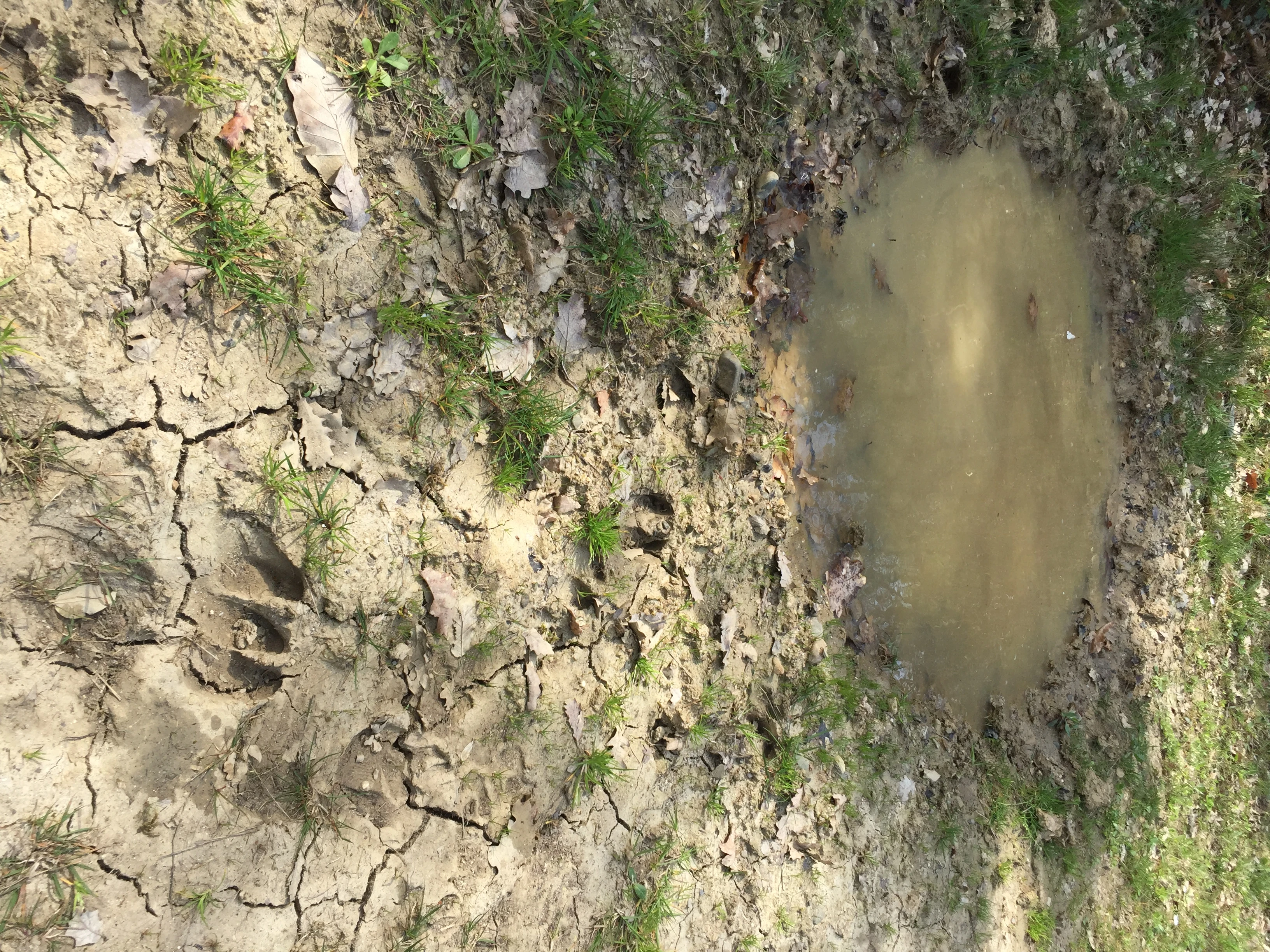
The next day, still fairly hungover from the night before, I take Diane for a walk. We pass through a dense part of the woods, with plenty of cover on steep slopes running down to the river. We pass two wallows. The boar are definitely here.
 Farther on, I see Diane pick up a scent. I smell it too: wild boar, that distinctive odor. Then I suddenly hear rustling and see her. A sow, bristles raised and tail curled up high. Mama is angry, very angry. That much is clear.
She is standing nose to nose with Diane. Then the sow attacks. Diane is not afraid, but she is sensible. She turns and runs. The dog races straight past me with the sow at her heels. I can follow them along the path and see that after about 50 meters, the sow has apparently had enough. She turns around and starts walking back. Well, that puts me in a tight spot.
I look for a tree I can shelter behind and climb if necessary. My respect for this angry pig borders on fear, I freely admit it. But the pig disappears into the cover. I hear a grunt. Apparently the sow is calling her piglets, or perhaps she is grunting while she is at the farrowing nest.
I wait a little longer to make sure the coast really is clear, then walk back to the farm with Diane, rather sobered up by now.
Two days later, I am walking with Diane along the river. I have managed to catch some small fish with a small square lift net and used those fish to bait and set a few lines, which I now want to check. Every year, I manage to catch a few eels here this way. They are usually not small ones, either.
A hunter once caught me doing this and asked why I used small fish. He thought you were supposed to use worms. "With worms, you catch worms," I replied, recalling an old piece of poachers' wisdom.
Suddenly, I see Diane staring intently at a patch of cover. I hiss at her to stay with me and follow her gaze. At first I see nothing, but I keep standing there, perfectly still, and watch. Then I see a wild boar emerge from the cover. A sow, possibly the same one as two days ago. She has apparently not noticed us, because she walks straight to the river for a drink without hesitation. Apparently she also needs to drink during the day to keep the milk machine running.
Speaking of the milk machine, she must have quite a few piglets, because a whole row of teats hangs beneath her belly. Stretched taut. It reminds me of our dachshund. When she had surgery to remove her inflamed uterus, she soon developed udders just as full. An emergency visit to the veterinarian taught us that this happens more often. "The body thinks: uterus empty, start making milk," he said. "Around here, we also call it Dolly Parton syndrome."
Without a glance around, the sow disappears back into the cover.
©TheoM