
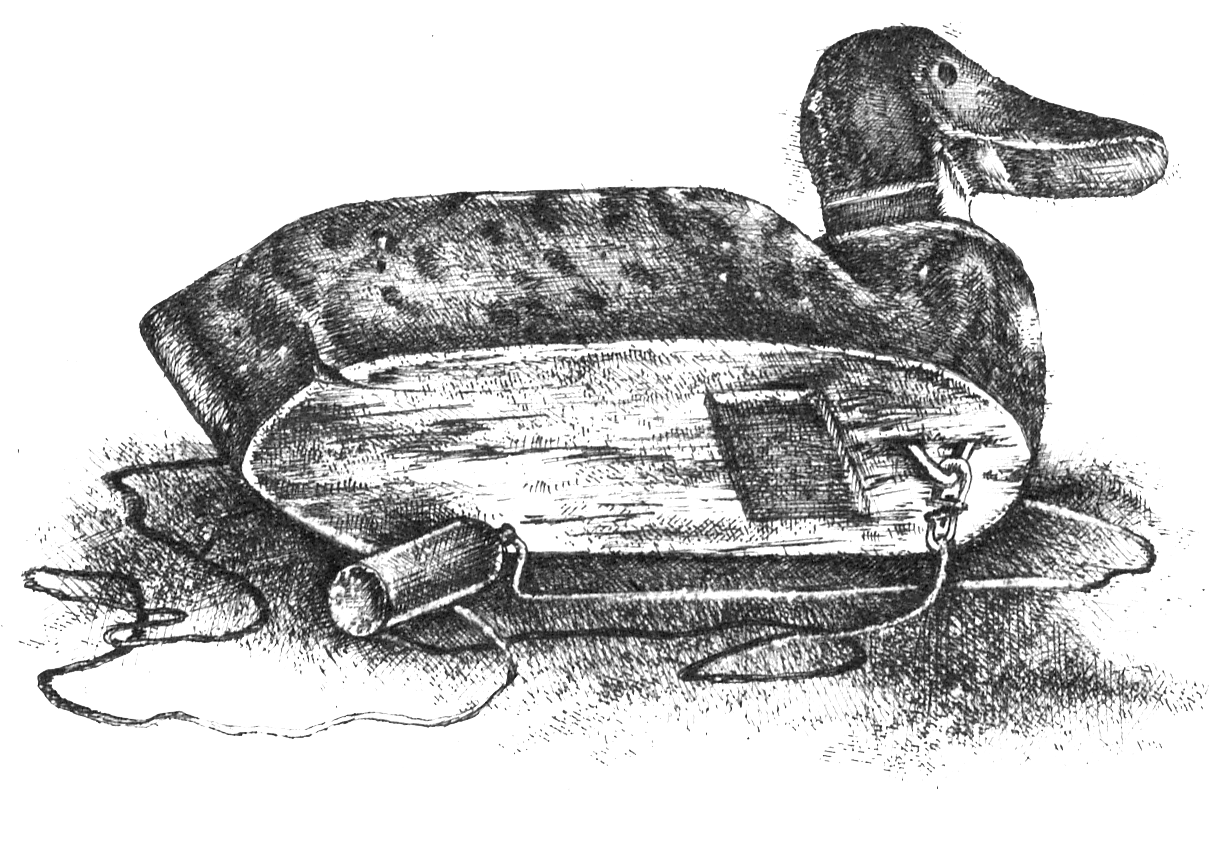
Duck Hunting
On the 15th, I'm out duck hunting with B. and R. Well, duck hunting; we're after geese, shoot the odd pigeon too, and walk along a ditch bank, which gives us the chance to shoot two ducks. "How did you do it in the old days?" I'm asked. "You had those duck hunting ponds back then, didn't you? And you used to talk about drakes you let fly loose. How did that work?" Perhaps I'll leave those duck ponds for another time, but hunting from a blind with those flying decoy drakes is certainly a fond memory. Back when I was still a true small-game hunter, you spent weeks looking forward to it. Not August 15, but July 24, the opening of duck season.
And you should take that buildup quite literally. It wasn't a matter of getting everything ready the evening before, or arranging the who, what, where, and when with friends and/or guests a few days beforehand. No, it was the how, because that took several weeks of preparation.
I never hear about it anymore, so perhaps I'm giving away a secret tip: vliegwinders. (Winder means drake, a term used in the lake district around Utrecht.)
Anyone who hunts geese, pigeons, or crows knows that movement in the decoy spread adds to its pulling power, and ducks are no different. Hunting success increases enormously when you combine a decoy spread with ducks that fly and settle among your decoys.
The fact that I no longer use flying decoy drakes probably has something to do with big game having become part of my hunting life, leaving me less focused on July 24 or August 15. And, of course, with the fact that where I live now, keeping a flock of live decoys is no longer possible without practical difficulties.
Back then, we lived beside a lake. A handful of feed each day kept plenty of ducks around the house. Each year, we banded a few new ones if necessary, if it was necessary at all, because we lost very few and, as it turned out, they could live to quite an age.
In early June, we put a few drakes in a pen right next to the pen holding the ducks for the decoy spread. The rest is fairly simple. Make sure you get these drakes extremely tame by feeding them only from your hand, talking and calling to them as you do. And at first, keep their rations a little short.
The next step is to practice and teach them the trick by regularly picking them up during feeding and tossing them into the air. Once they've landed, call them, pick them up, and put them back in the pen, with a few kernels of corn as a reward. Every now and then, we fired a blank pistol. Another matter of conditioning: bang = food.
Then July 24 would come. The decoy ducks were out on the water around a blind on the lake, and whenever ducks were flying, we'd take a flying decoy drake from the crate and toss it into the air. At first, we often tied a long piece of string to a leg, because the new ones hadn't yet learned to jump into the boat for their corn and sometimes had to be pulled in.
Those first few times were always tense moments. Would they settle on the water among the decoys, or fly away, hopefully home? But if it works and they settle, call them and try to get them over to the boat.
They soon get the hang of it. Fly, settle, and jump into the boat = food.
The effect is comparable to a rotary crow or pigeon decoy, only more realistic. A magnet!
©TheoM